Chicken Cobbler with a Golden Biscuit Top: Step-by-Step Instructions
Instructions
- Heat the oven to 190 °C (170 °C fan, 375 °F). Put the butter in a 23 x 33 cm (9 x 13 in) baking dish and slide it into the oven for about 5 minutes, until it has melted and just stopped foaming. The butter is not a greasing step: it stays as a layer at the bottom, and the batter later floats on it. That is what gives the finished top its fried, lacy edges.
- Soften the onion and carrot in a frying pan with a splash of oil for 8 minutes over a medium heat, until the carrot gives slightly under a knife tip. Forty-five minutes under a batter lid is gentle steaming, not roasting, so raw carrot added at this stage stays hard in the finished dish.
- Scatter the shredded chicken, the softened onion and carrot, and the frozen peas evenly over the melted butter. Do not stir them in. Every layer in a cobbler has to stay where you put it; mixing at any point collapses the structure into a thick soup with a pale crust.
- Whisk the biscuit mix and the milk together in a jug until smooth. The ratio is the whole trick: equal volumes of mix and milk, with half that volume of butter underneath. The batter should pour like single cream and run off the whisk in a ribbon, not drop off in lumps.
- Pour the batter slowly across the whole surface, moving the jug from one end of the dish to the other. This is where chicken cobbler parts company with a biscuit-topped pie: the batter is poured, not spooned. A poured batter spreads into one continuous sheet that seals the filling and climbs the sides of the dish. Spooned mounds leave gaps and bake into separate scones.
- Whisk the hot stock with the condensed soup, onion powder, thyme, salt and pepper until there are no lumps. Pour it gently over the batter, letting it fall over the back of a large spoon so it spreads rather than drilling a hole in one spot.
- Resist the urge to mix. The stock sits heavy on top and the batter is lighter, so during baking the two swap places: the liquid sinks into the chicken and thickens there, while the batter rises to the surface and sets. Stirring now gives you a dumpling stew instead of a cobbler.
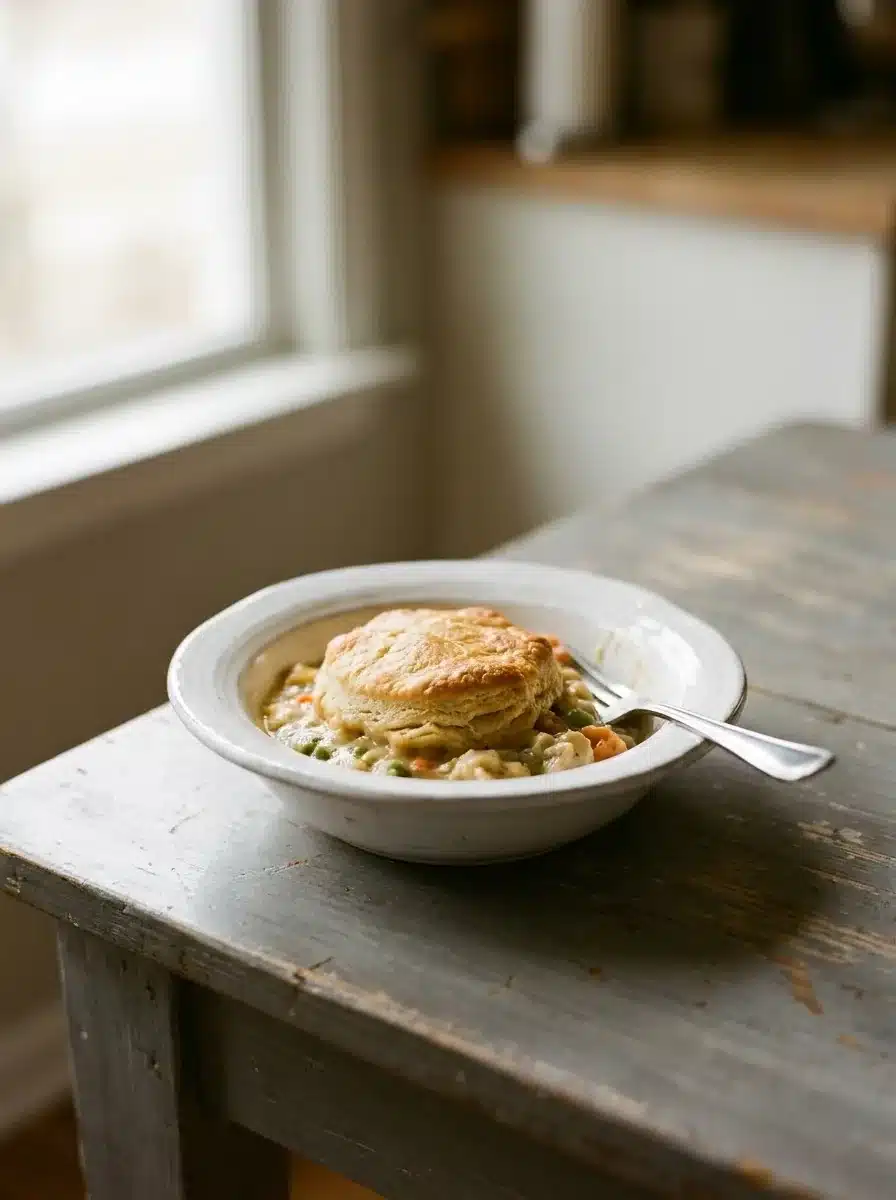
- Bake uncovered for 45 minutes, until the top is deep golden and the sauce bubbles up visibly around the edges. The dish will look alarmingly wet at the 20-minute mark; that is normal, and it is the point at which most cooks wrongly reach for more flour.
- Test the centre with a skewer: it should come out with soft crumb on it but no raw batter. If the top is browning faster than the middle sets, lay a sheet of foil loosely over it for the last 10 minutes.
- Rest the dish on the worktop for 10 minutes before serving, then scatter the parsley over. The sauce is thin straight from the oven and thickens as it cools; spooning it out immediately gives you a puddle on the plate.
Recipe Variations
Cheddar and chive top. Stir 80 g of grated mature cheddar and a tablespoon of snipped chives into the batter. Add 2 tablespoons of extra milk, since the cheese thickens it.
Mushroom and leek. Replace the carrot with 200 g of sliced chestnut mushrooms and a sliced leek, both cooked until their water has evaporated. Wet mushrooms will thin the sauce.
Turkey after a roast. Leftover turkey works in exactly the same quantity, and the darker meat suits the thyme better than chicken does.
Spiced version. A teaspoon of smoked paprika and a pinch of cayenne in the stock mixture gives the sauce colour and a low background heat without changing the method.
Smaller dish for four. Halve everything and bake in a 20 cm square dish for 35 minutes. The batter layer stays the same depth, which is the measurement that governs the timing.
Serving Ideas
This is a whole meal in a dish, so what goes beside it should be sharp rather than substantial. Dressed watercress, a tomato salad with red onion, or green beans with lemon all cut through the butter without competing.
If you are feeding people who expect a potato, roast new potatoes are a better match than mash — the dish already has a soft starch layer, and adding a second one makes the plate heavy.
For a buffet, bake it in two smaller dishes rather than one large one. More edge means more of the crisp, butter-fried border that people reach for first, and smaller dishes also hold their heat better once the serving spoon has been in a few times.
Keeping It Fresh
Cover and refrigerate leftovers for up to three days. The crust softens overnight as it draws moisture from the sauce, which is unavoidable, but it crisps up again in a hot oven.
Reheat portions uncovered at 180 °C for 15 to 20 minutes rather than in the microwave. Microwaving warms the filling fast and leaves the top limp and slightly rubbery, since the crust needs dry heat to recover.
Freezing is possible but the texture suffers: the batter layer becomes dense and the peas go soft. If you do freeze it, portion it first, wrap each piece well, keep it no longer than two months, and reheat from frozen at 170 °C for about 40 minutes with foil on for the first half.
Reader Questions Answered
What exactly is the difference between a cobbler and a biscuit bake?
The consistency of the topping before it goes in. A biscuit bake uses a stiff dough dropped in spoonfuls, which bakes into separate rounds with filling visible between them. A cobbler uses a pourable batter spread over the whole surface in one go, so it sets as a single crust with a soft underside where it met the sauce.
Can I make the biscuit mix from scratch?
Yes. For 250 g, whisk 250 g plain flour with 4 teaspoons baking powder, 1 teaspoon salt and 2 teaspoons caster sugar. Rub in 50 g cold butter if you want it richer, but keep the milk quantity the same so the batter still pours.
Why does my top sink in the middle?
Almost always too much liquid poured in one place, which punches through the batter. Pour the stock over the back of a spoon and keep moving. A cold milk straight from the fridge also slows the rise, which is why the batter is best made with milk at room temperature.
Can I use raw chicken?
Not in this method; 45 minutes under a wet batter is not reliable cooking for raw meat. Poach 600 g of chicken thighs for 20 minutes first, then shred. The poaching liquid can replace the stock, which improves the sauce.
Can it be assembled ahead?
The filling layer can be prepared and refrigerated a day ahead in the dish, with the butter already in it. Mix and pour the batter and the stock only when the oven is hot — the raising agent starts working the moment the milk goes in, and a batter left to stand bakes flat.
Wrapping Up
Butter in the dish, filling on top, batter poured over, stock poured over that, and then nothing for 45 minutes. The hardest part is trusting a tray of liquid that looks wrong at the halfway mark.
Once you have made it once and seen the batter arrive at the surface on its own, the method stops feeling like a trick and becomes a template. Any cooked meat and any firm vegetable will go underneath it, as long as the mix, the milk and the butter stay in proportion.
Related recipes: Baked Spinach Artichoke Dip with Three Cheeses, Breakfast Burritos with Egg, Cheese and Potato, Garlic Butter Chicken Thighs with Lemon, Chicken Gnocchi Soup with Spinach and Carrots, High Protein Jello Cups Greek Yogurt.
Learn more: Chicken on Wikipedia · food storage & safety (FoodSafety.gov).
◆ ◆ ◆
← Back to Chicken Cobbler with a Golden Biscuit TopGet new recipes
One tasty homemade recipe in your inbox each week. No spam, unsubscribe anytime.


Comments (11)