Chicken Cobbler with a Golden Biscuit Top

Chicken cobbler layers shredded roast chicken and vegetables under a poured biscuit batter that rises through a creamy stock as it bakes for 45 minutes.
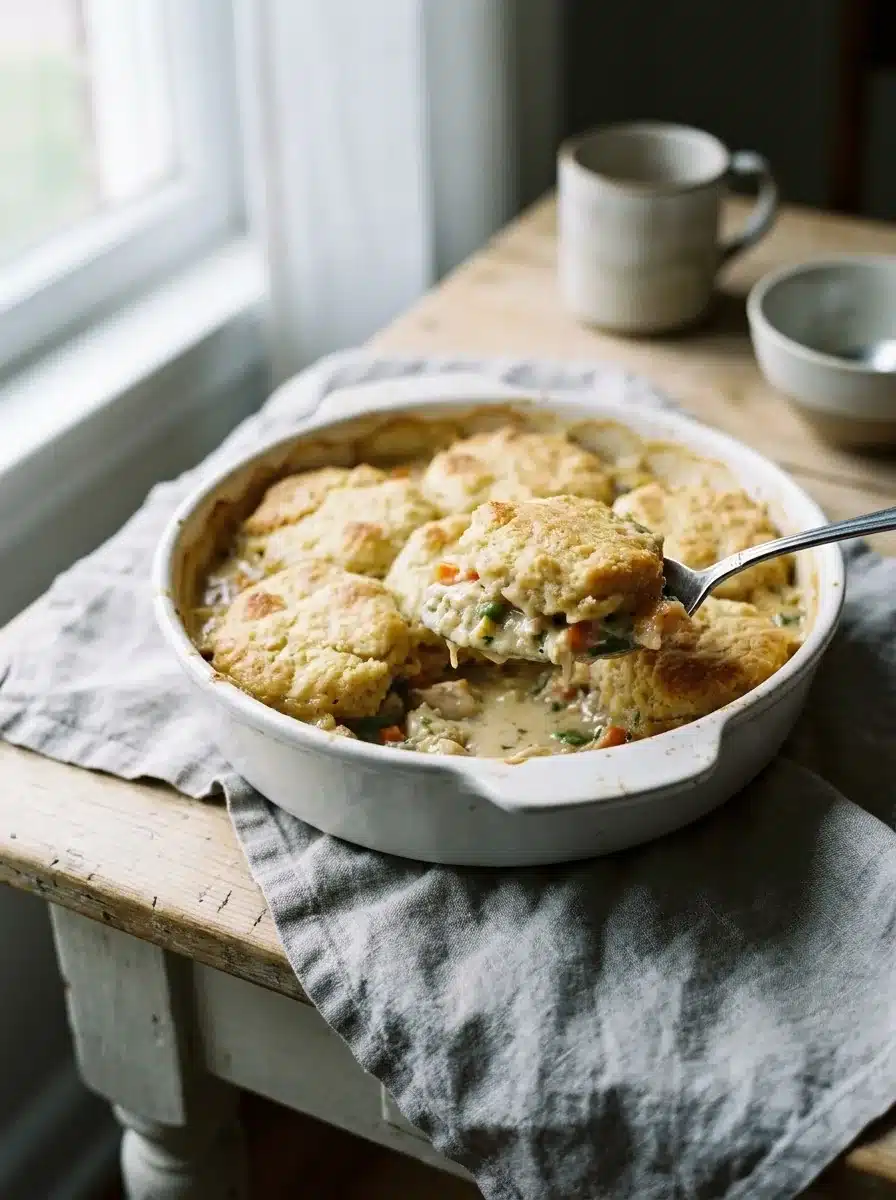
Chicken cobbler is built in layers and then left alone. Melted butter goes into the dish first, shredded roast chicken and vegetables on top of it, a loose biscuit batter poured over that, and finally a creamy stock ladled across the surface. Nothing is stirred. In the oven the batter rises up through the liquid and sets into a single golden lid with soft, gravy-soaked edges. Forty-five minutes, one dish, six servings.
| Prep Time | 20 | Cook Time | 45 |
| Servings | 6 | Calories | 545 kcal |
Ingredients
- 115 g (1 stick / 8 tablespoons) unsalted butter
- 550 g (1 lb 4 oz) cooked roast chicken, shredded — about 4 cups, or one medium rotisserie bird
- 1 small onion (about 100 g / 3.5 oz), finely chopped
- 2 medium carrots (about 150 g / 5 oz), cut into 5 mm (quarter-inch) dice
- 150 g (1 cup) frozen petits pois, straight from the freezer
- 250 g (2 cups) plain biscuit mix, or a self-raising flour blend
- 480 ml (2 cups) whole milk, at room temperature
- 480 ml (2 cups) hot chicken stock
- 1 tin (295 g / 10.5 oz) condensed cream of chicken soup
- 2 teaspoons onion powder
- 1 teaspoon dried thyme
- ½ teaspoon fine salt and ½ teaspoon ground black pepper
- 1 tablespoon chopped flat-leaf parsley, to finish
Everything here is ordinary, and the quantities matter more than the quality. The three numbers to remember are 2 cups of biscuit mix, 2 cups of milk and half a cup of butter: that one-to-one mix-to-milk ratio is what turns a dough into a batter loose enough to pour, and the butter underneath is what stops it sticking to the base while it rises.
Shop-bought roast chicken is the usual starting point because it is already seasoned and it shreds in minutes, but any cooked chicken works as long as it is pulled into strands rather than cubed. Strands tangle together and hold the sauce; cubes sink and leave the bottom of the dish watery.
Essential Kitchen Tools
| 23 x 33 cm baking dish | Ceramic or glass, at least 6 cm deep |
| Large measuring jug | Mixing the batter and pouring it evenly |
| Balloon whisk | Smoothing the batter and the stock mixture |
| Frying pan | Softening the onion and carrot first |
| Large metal spoon | Breaking the fall of the stock over the batter |
Depth matters more than the exact footprint. A shallow tin will overflow within the first 15 minutes, because the batter roughly doubles as it climbs.
Why This Recipe Works
The whole dish turns on a density difference. The batter is full of air pockets created by the raising agent, so it is lighter than the stock poured over it. As the oven heats everything through, the heavy liquid works its way down into the chicken and the light batter is displaced upwards. By the halfway point the two layers have traded places entirely, with no help from the cook.
That upward journey is also what cooks the crust properly. A topping sitting on wet filling from the start steams from below and stays doughy underneath — the usual complaint about biscuit-topped bakes. Here the batter arrives at the surface part-set and finishes in dry oven heat, so it browns rather than sogs.
Underneath, the condensed soup is doing unglamorous but necessary work. It carries enough starch to bind 480 ml of stock into a sauce without anyone making a roux, and it does so slowly, which is why the filling is still loose at 20 minutes and properly thick at 45.
Pro Tips for Better Results
Measure the batter by volume, not by eye. An extra half-cup of mix makes it too stiff to pour, and the layer breaks up. An extra half-cup of milk and it will not rise through the stock at all.
Use room-temperature milk. Cold milk stiffens the melted butter it eventually meets and slows the rise in the first critical ten minutes.
Pour the stock last and pour it slowly. The order is butter, filling, batter, liquid. Reverse any two of those and the dish behaves differently.
Never stir after assembling. This is the single rule that separates a cobbler that works from one that does not.
Keep the peas frozen. Thawed peas turn grey and collapse over 45 minutes; frozen ones hold their shape and colour.
Let it rest. Ten minutes out of the oven lets the starch finish setting, and the portions come out of the dish in one piece instead of sliding apart.
Nutrition Facts (per serving)
| Calories | Protein | Carbs | Fat | Fiber |
|---|---|---|---|---|
| 545 kcal | 33g | 40g | 28g | 3g |
Based on one of six portions of the finished dish, with no side. Dropping the butter to 60 g and using semi-skimmed milk brings it to roughly 470 kcal, at the cost of some crispness at the edges.